
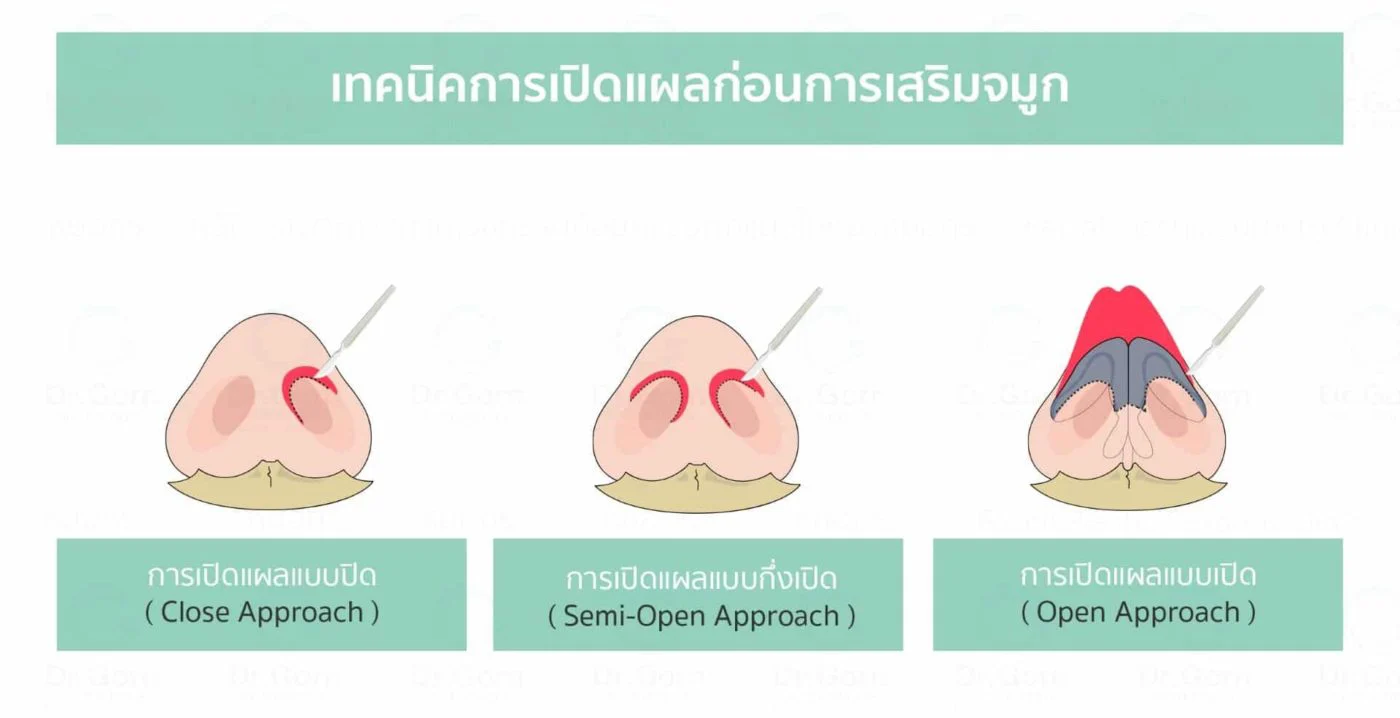
There Are 3 Main Incision Techniques for Rhinoplasty
- Closed Technique
- Semi Open Technique
- Open Technique
1. Closed Technique
This technique involves making an incision inside one nostril.
Advantages
- A simpler and more convenient approach to nasal augmentation than the other techniques.
- Less swelling and bruising, which may allow a shorter recovery period.
Disadvantages
- May carry a higher risk of nasal deviation than the other techniques.
- May carry a higher risk of nostril asymmetry due to contraction of the surgical scar on one side and the surgeon’s more limited view of the surgical field.
- Generally less suitable for correcting a short nose or performing revision rhinoplasty.
2. Semi Open Technique
This technique involves making incisions inside both nostrils.
Advantages
- May reduce the risk of nasal deviation and nostril asymmetry.
- Provides better access for correcting existing nasal structural problems than the closed technique.
- Provides the surgeon with a wider view of the surgical field than the closed technique.
Disadvantages
- Requires more operating time.
- May offer less comprehensive correction of the following concerns than the open technique:
- A short nose
- A crooked nose
- A large nasal tip
- Asymmetric nostrils
3. Open Technique
This technique combines an external incision across the columella, the tissue between the nostrils, with the internal incisions used in the semi open technique. It provides a clearer view of the nasal structures than the closed and semi open techniques. This allows the surgeon to address existing structural concerns with greater precision and detail through open nasal reconstruction or structural rhinoplasty.
Advantages
- Provides the clearest view of the surgical field among the techniques described above.
- Suitable for procedures requiring precise surgical work, particularly nasal tip refinement and revision rhinoplasty.
- Suitable for narrowing a very wide bony nasal base using two osteotomy approaches: median oblique and lateral osteotomy.
- Suitable for lengthening the nasal framework in patients with a short nose.
- Provides greater access for detailed correction of existing nasal structural concerns through open nasal reconstruction or structural rhinoplasty.
Disadvantages
- Requires more operating time.
- Generally costs more than the other techniques.



