

Hello, I am Dr. Gorn, joined by our medical team. We are back with more helpful information about troublesome under-eye bags. You can also watch our videos on the Dr. Gorn Aesthetique Channel.
Previously, we explained under-eye bags and their causes. Now, you may be wondering how they can be treated. There are two main approaches to correcting under-eye bags:
1. Camouflage Filling
Camouflage filling involves injecting a filling material around the under-eye bags to create a smoother contour.
This approach does not directly remove or alter the bags. Instead, volume is added beneath or around them to make the surrounding area appear more even.
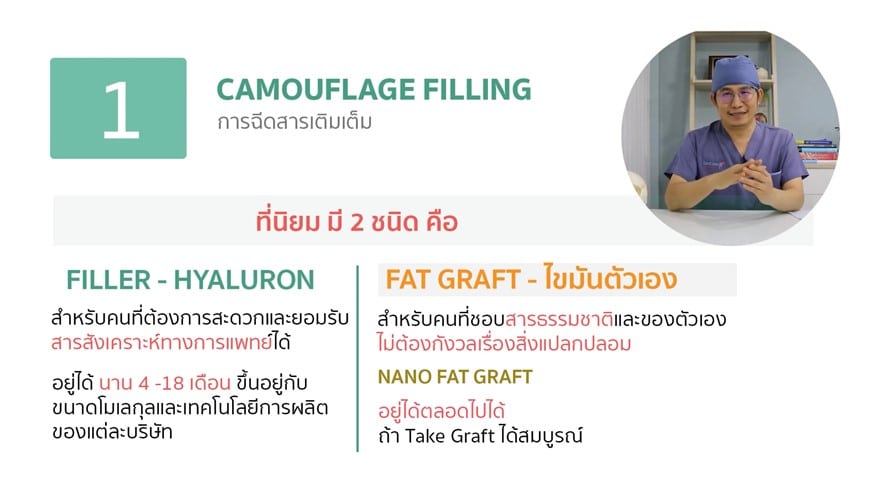
Two commonly used filling materials are:
Hyaluronic Acid (HA) Fillers
HA fillers are manufactured medical products. They may suit people who prefer convenience, minimal downtime, and are comfortable using a manufactured filling material.
A common question is how long the results last. This depends on the filler formulation and the manufacturing technology used by each company and brand.
Some finer-textured HA fillers can create a smooth appearance but may have a shorter duration, approximately 4–6 months. More robust formulations may last longer, although certain products can be more noticeable or appear lumpy in the thin under-eye tissues.
For people who prefer treatment using their own tissue, fat grafting is another popular option.
Autologous Fat Grafting
This approach uses the patient's own fat and may suit those who prefer their own tissue to a manufactured filler. For the under-eye area, experienced surgeons may use specially processed fat, including techniques such as nanofat grafting. Fat is harvested from areas such as the lower abdomen or thighs, including the inner thighs, and processed into a finer preparation for delicate treatment areas. The preparation and injection technique are selected according to the patient's needs.
One advantage of fat grafting is the potential for long-lasting results, although some of the transferred fat may not survive. When the graft successfully establishes a new blood supply that nourishes the fat cells, the surviving cells can remain long term.
It is therefore an option for people who prefer treatment using their own tissue rather than a manufactured filling material.


2. Eye Bag Surgery
The second approach treats the under-eye bags directly through surgery. There are two main surgical methods, selected according to each patient's anatomy and needs.
Fat Removal
The first method involves surgically removing selected excess orbital fat when the under-eye bags are too prominent.

Fat Repositioning
The second method is orbital fat repositioning, which may suit patients with a recessed cheek or lower orbital rim. The surgeon moves fat from the under-eye bags into the area along the lower orbital rim. This can address both the protruding bags and the hollow tear troughs.

You may now be wondering: where is the incision made during eye bag surgery?
There are two main surgical approaches:
Internal Incision (Transconjunctival Lower Blepharoplasty)
This approach uses an incision inside the lower eyelid, leaving no visible external scar. It may suit patients who only need treatment of the fat causing their under-eye bags, without removal of excess skin. The surgeon accesses and removes selected excess fat through the inner lower eyelid incision.

External Incision (Subciliary Lower Blepharoplasty)
An external approach is often selected for patients with excess lower eyelid skin, substantial under-eye wrinkles, or those undergoing an additional lifting procedure to improve the cheek and nasolabial fold area.
The incision is usually placed approximately 2 millimeters below the lower lash line. The scar generally becomes less noticeable as it heals, although healing and scar visibility vary between individuals.

You now have a clearer understanding of under-eye bags and how doctors select an appropriate treatment approach.
If you are considering treatment, consult a qualified specialist for an assessment and a treatment plan suited to your individual needs.



