
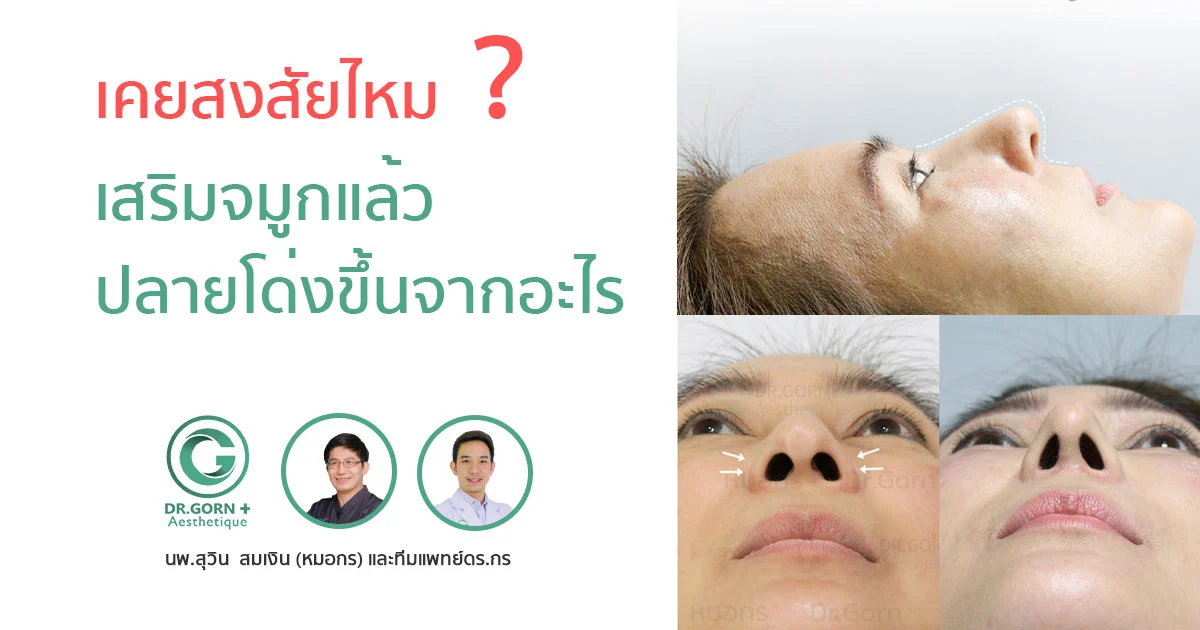
There are several ways to increase nasal tip projection, and each technique produces a different type of enhancement. Understanding these differences can help you choose an appropriate approach and achieve a result that best matches your goals. Let us look at each method.
Increasing Nasal Tip Projection with Filler Injections
This method is popular among people who prefer to avoid surgery. Hyaluronic acid fillers are commonly used. The degree of projection depends on the amount injected, but adding volume can also make the nasal tip appear larger. Injections placed too superficially may cause skin problems.
Dr. Gorn does not recommend filler injections into the nasal tip because complications can be difficult to correct. His approach favors limiting any consideration of nasal filler to the bridge rather than the tip. This should not be interpreted as meaning that bridge injections are risk-free.

Increasing Nasal Tip Projection with Threads
The technique described here relies on the thickness of the threads to support and elevate the nasal tip. Thicker threads therefore require fewer strands than thinner threads. However, the degree of enhancement is limited, and the results are temporary. This method is particularly unsuitable for patients with thin nasal tip skin, as the threads may become visible beneath the skin.

Increasing Nasal Tip Projection with a Silicone Implant
Silicone rhinoplasty is widely used because it can produce a noticeable increase in nasal tip projection. The tip portion of the implant adds height, while its columellar extension provides support to elevate the tip. This technique is relatively straightforward and generally involves a shorter recovery period, contributing to its popularity.
However, silicone tip augmentation can cause problems if the implant is too long or too large, or if its columellar extension is too thick. Possible complications include thinning of the nasal tip skin, visible implant edges, and implant extrusion through the tip or inside a nostril.
For patients with a thick, bulky nasal tip, increasing projection with silicone alone may not make the tip appear slimmer. Likewise, patients who want flat, horizontally oriented nostrils to appear more vertically oval may benefit from structural rhinoplasty. Silicone augmentation mainly increases the height of the soft tissues at the tip without repositioning the underlying lower lateral cartilages. As a result, the nostrils may remain wide rather than becoming narrower and more upright.
An excessively thick tip portion of the implant may also place pressure on the nostrils and make them appear flatter.

Increasing Nasal Tip Projection with a Silicone Implant and Tip Onlay
This technique is similar to silicone tip augmentation, but adds ear cartilage, soft fatty tissue from behind the ear, or a tissue substitute over the implant tip. The additional layer is intended to reduce the risk of tip skin thinning and may add approximately 3–4 millimeters of tip length.
The achievable change also depends on the elasticity of the nasal tip tissues. If the implant is too long, skin thinning can still occur despite the protective layer. Other possible problems include a non-healing wound inside the nostril, chronic nasal infection, or later extrusion of the implant's columellar extension into the nostril. The implant length must therefore be carefully selected, even when a tip onlay is used, to support an attractive and safe result.
Increasing Nasal Tip Projection with Semi-Open Rhinoplasty and an Entirely Ear-Cartilage-Based Tip
This technique has been developed and refined at Dr. Gorn Clinic. Ear cartilage replaces both the tip portion and the columellar extension of the silicone implant to shape and support the nasal tip. Silicone is used only along the nasal bridge.
The technique uses cartilage-based tip reconstruction, as in some open rhinoplasty approaches. It may be suitable for patients with thin nasal tip skin who wish to avoid silicone at the tip, or for revision cases involving tip thinning caused by a silicone implant.
However, this technique generally provides less nasal lengthening than open structural rhinoplasty using septal cartilage or rib cartilage to extend the tip.

Increasing Nasal Tip Projection with Structural Rhinoplasty Without Silicone
This approach is more complex and requires considerable surgical expertise. It aims to create a more refined, natural-looking tip and more vertically oval nostrils by elevating and bringing the lower lateral cartilages closer together. Septal cartilage, rib cartilage, or a synthetic material such as Medpor may be used for structural support. Ear cartilage can provide additional tip refinement, and selected excess soft tissue around the supratip may be reduced through supratip debulking. These adjustments aim to improve the proportions between the nasal tip and the nostrils.
Structural rhinoplasty may help make the tip appear slimmer and the nostrils more upright, rather than flattened or spread outward by a large silicone implant. In addition to increasing tip projection, it can address a short nose, a thick or bulbous tip, a deviated nasal tip, tip skin thinning or implant extrusion, asymmetrical nostrils, and nasal obstruction caused by internal structural problems. The appropriate corrections depend on each patient's anatomy.



