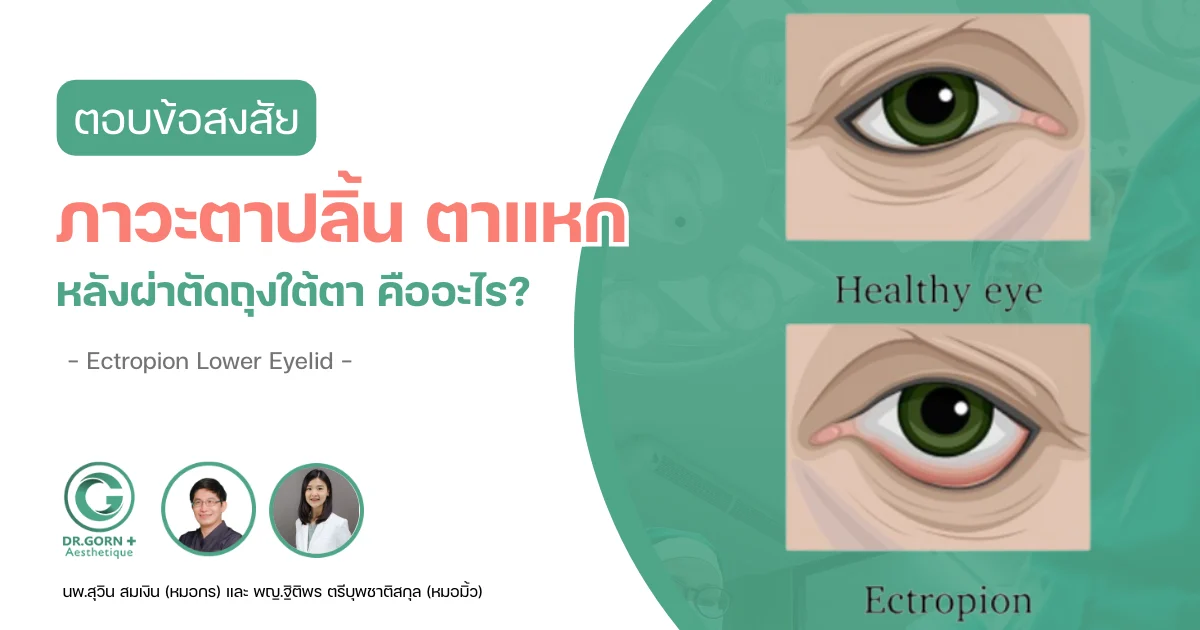
Lower eyelid ectropion is a condition in which the lower eyelid margin turns outward and no longer rests properly against the eyeball. It may result from several causes, including age-related eyelid laxity, weakness of the muscles surrounding the eyes, traction from a lesion near the eyelid, or scarring following an injury or surgical procedure. Lower eyelid ectropion is a recognized complication that can occur after lower blepharoplasty (under-eye bag surgery). The risk depends on both patient-related factors and the surgical technique used.


Patient-Related Risk Factors for Lower Eyelid Ectropion
- Older age: Aging can weaken the supporting structures of the eyelids and increase tissue laxity, making the lower eyelid more susceptible to outward turning.
- Reduced lower orbital or cheekbone support: Certain facial skeletal configurations, including a negative orbital vector, may increase susceptibility to lower eyelid malposition.
- Frequent eyelid rubbing: Repeatedly rubbing or pulling the eyelids may contribute to stretching of the tissues, along with irritation, wrinkles, or pigmentation changes.
- Long-term contact lens use: Repeated manipulation and pulling of the eyelids during contact lens insertion or removal may contribute to tissue laxity in some individuals.
- Previous eyelid trauma: A history of injury may involve orbital bone fractures, changes in bony support, or scars that pull on the lower eyelid.
- Previous eyelid surgery or injections: Earlier procedures or injections involving the lower eyelid may lead to scar tissue or adhesions, making subsequent surgery more complex and potentially affecting wound healing.
Surgery-Related Risk Factors
- Excessive skin removal: Removing too much lower eyelid skin during blepharoplasty can create downward traction and increase the risk of ectropion or lower eyelid retraction.
- Injury to the orbicularis oculi muscle: A transcutaneous surgical approach may affect the muscle surrounding the eye, which is important for eyelid closure and support. Excessive tissue disruption or scarring can contribute to lower eyelid malposition.
How Is Lower Eyelid Strength and Stability Assessed?
- Assessment of lower eyelid laxity.
- Horizontal eyelid laxity: Assessed using methods such as the Canthal Tendon Laxity Test and Eyelid Distraction Test.
- Lower eyelid recoil: Assessed using the Eyelid Snap-Back Test, which helps evaluate how readily the eyelid returns to its normal position after being gently pulled downward.
- Assessment of the function and strength of the orbicularis oculi muscle. The patient is asked to close the eyes normally and then squeeze them tightly shut. With normal muscle function, the eyelids should close completely and demonstrate adequate closing strength. Incomplete eye closure or weak eyelid squeezing may indicate the need for further evaluation, including assessment for facial nerve palsy. Facial nerve dysfunction may also be associated with facial asymmetry, a drooping mouth corner, or eyebrow descent. Reduced eyelid muscle function may also be observed in some older patients.


Orbital Vector Assessment Before Lower Eyelid Surgery
An orbital vector assessment evaluates the relative position of the globe and corneal prominence in relation to the lower orbital rim and midfacial bony support. The patient is asked to sit upright, keep the head straight, and look forward while the examiner evaluates the facial profile from a side view (sagittal view).
A negative orbital vector describes a facial configuration in which the globe projects farther forward than the lower orbital rim or supporting midfacial structures. Patients with this anatomy may have an increased risk of postoperative lower eyelid ectropion or lower eyelid retraction following lower blepharoplasty, depending on other anatomical and surgical factors.

Surgical Techniques That May Help Reduce the Risk of Ectropion
A detailed preoperative assessment helps the surgeon identify each patient's anatomical concerns and risk factors so that the surgical technique can be individualized. Patients with weak lower eyelid support or significant eyelid laxity may be at increased risk of postoperative ectropion. In these patients, conservative skin removal is especially important. The surgeon may also consider avoiding an external skin incision when the risk of postoperative scarring and downward traction is high. If the orbicularis oculi muscle is already weak, preserving its integrity is an additional consideration when choosing the surgical approach.
Patients with a negative orbital vector or insufficient lower orbital support may also be more susceptible to ectropion or lower eyelid retraction. For selected patients with these characteristics, the surgeon may consider a transconjunctival lower blepharoplasty, in which the incision is made through the inner lining of the eyelid rather than the external skin. However, the best approach depends on the patient's anatomy and treatment goals; the transconjunctival technique does not eliminate all risks.
Regardless of whether a transcutaneous or transconjunctival approach is selected, careful handling of the orbital septum and surrounding structures is essential. Suturing or tightening procedures must be performed appropriately to avoid excessive traction, scar formation, or distortion of the lower eyelid. Other surgical considerations include minimizing unnecessary tissue injury and excessive cauterization, which may contribute to postoperative fibrosis.
A comprehensive examination by a qualified specialist before lower blepharoplasty is therefore important for identifying individual risk factors and selecting the most appropriate surgical technique.
Important Points to Know Before Under-Eye Bag Surgery
Patients considering lower blepharoplasty should understand the surgical factors that may help reduce the likelihood of postoperative lower eyelid ectropion or retraction. The following precautions are particularly important:
- Preserve lower eyelid skin: In patients with weak eyelid support, excessive removal of lower eyelid skin should be avoided. An external skin incision may also require careful consideration because scar contraction can pull the eyelid outward.
- Protect the orbicularis oculi muscle: If the muscle surrounding the eye is already weak, the surgeon should consider techniques that minimize injury to this muscle and avoid unnecessary muscle removal.
- Consider the orbital vector: Patients with reduced lower orbital support or a negative orbital vector may be more vulnerable to lower eyelid malposition. A transconjunctival approach may be appropriate in selected cases, depending on the surgical assessment.
- Minimize tissue trauma and scarring: Careful handling of the orbital septum, appropriate suturing techniques, and avoidance of excessive cauterization may help reduce unnecessary traction, fibrosis, and postoperative eyelid distortion.