Do Drooping Eyebrows Make You Look Older, Tired, or Affect Your Vision? Explore Nonsurgical and Surgical Brow Lift Options for Adults Aged 35 and Over

In addition to excess upper eyelid skin (Dermatochalasis) and upper eyelid ptosis (Blepharoptosis), brow ptosis, or drooping eyebrows, is another common age-related condition affecting the area around the eyes. The ideal eyebrow position and shape vary according to facial anatomy, sex, and personal preferences. Traditionally, male eyebrows tend to be relatively straight, with fairly consistent thickness along their length, and are commonly positioned near the superior orbital rim.
Female eyebrow shapes have traditionally been described as fuller toward the inner brow and gradually tapering toward the outer tail, with an arch typically located near the junction between the medial two-thirds and lateral one-third of the brow. However, eyebrow aesthetics change with fashion and individual preference. The highest point of the eyebrow, or brow peak, is often positioned around the lateral limbus or slightly farther outward, generally not beyond the lateral canthus. Female eyebrows are commonly positioned above the superior orbital rim, although natural anatomical variation is considerable.
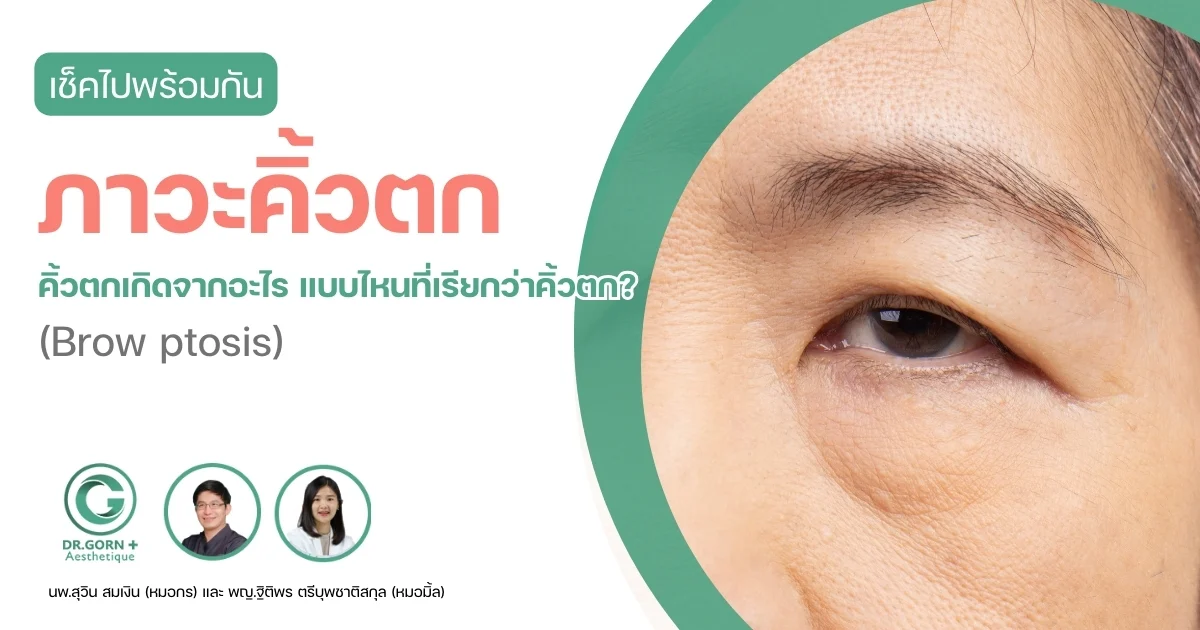
Brow Ptosis is a condition in which the eyebrows descend from their previous position. It becomes more common with age, particularly from around 35 years onward, as the skin and supporting tissues gradually lose elasticity. The resulting changes may include:
- A tired, stressed, or less refreshed facial appearance.
- Drooping outer eyebrows that make the face appear sad.
- Lowering of the inner eyebrows, creating a more stern facial expression.
- Obstruction of the upper visual field in more pronounced cases.
- Forehead muscle fatigue or discomfort caused by repeatedly raising the eyebrows to improve vision.
Beyond cosmetic concerns, significant brow ptosis can interfere with vision by allowing the brow and adjacent tissues to obstruct the upper visual field. This may become more pronounced when eyebrow drooping occurs alongside upper eyelid ptosis or excess upper eyelid skin. Such combined conditions are particularly relevant in older adults, regardless of sex.
In severe cases, the descending brow and upper eyelid tissues may contribute to abnormal positioning of the eyelid margin or eyelashes. If eyelashes repeatedly rub against the cornea, patients may experience irritation, tearing, discomfort, corneal abrasions, or blurred vision. Corneal damage may also increase the risk of infection. Some patients experience forehead fatigue or headaches because the frontalis muscle continuously contracts to elevate the eyebrows and compensate for visual obstruction.
How Can You Tell If You Have Brow Ptosis?
When assessing brow position, it is important to determine whether the patient is actively contracting the frontalis muscle. This muscle raises the eyebrows and may temporarily conceal their naturally lowered position. Horizontal forehead lines can suggest frequent frontalis activity, although they may also represent permanent static wrinkles. During examination, the patient is usually asked to sit upright, keep the head straight, and look forward. The examiner can gently stabilize the forehead to reduce compensatory frontalis activity and then assess the resting position of the eyebrows. Eyebrows positioned below the superior orbital rim may indicate brow ptosis, although normal position varies with individual anatomy and sex.
Special care is required when evaluating patients with tattooed or microbladed eyebrows. The cosmetic eyebrow design may be located higher than the patient's natural eyebrow hairs, making the brows appear correctly positioned even when the underlying natural eyebrows have descended. A careful examination of the original eyebrow anatomy is therefore important.
What Causes Drooping Eyebrows in Adults Aged 35 and Over?
Brow ptosis may develop because of age-related tissue changes, inappropriate botulinum toxin injection placement, weakness of the frontalis muscle, previous facial or forehead surgery, trauma, or neurological conditions such as Bell's palsy. From a clinical perspective, brow ptosis can be divided into two main categories: congenital brow ptosis and acquired brow ptosis.
- Congenital Brow Ptosis: Some patients naturally have low-set eyebrows because of their facial anatomy from birth. A detailed history and photographs taken earlier in life may help distinguish a naturally low eyebrow position from acquired brow descent.
- Acquired Brow Ptosis: This condition can result from several causes and may be divided according to its progression into the following groups:
- Temporary or Potentially Reversible Causes: Examples include facial muscle weakness associated with Bell's palsy, temporary frontalis weakness after botulinum toxin injections, and abnormal contractions of the orbicularis oculi muscle associated with conditions such as blepharospasm or facial dystonia. Excessive doses, inappropriate injection placement, or other treatment-related factors may contribute to temporary eyebrow descent. Addressing the underlying cause may improve the condition. In addition, certain eyelid or surrounding tissue lesions, including tumors such as basal cell carcinoma or squamous cell carcinoma, can alter the eyebrow position by affecting nearby structures. Such lesions require medical evaluation and may not be reversible without appropriate treatment.
- Persistent or Long-Term Causes: Age-related brow descent generally develops gradually as the supporting tissues change over time. Other causes include trauma involving the forehead muscles or their nerve supply, as well as injury associated with previous surgical procedures. Depending on the cause and severity, these changes may be persistent and may require specialist treatment.
Treatment Options for Drooping Eyebrows (Brow Ptosis)
Several treatments may be considered for brow ptosis. The most appropriate approach depends on the severity of eyebrow descent, the condition of the upper eyelids, whether vision is affected, and the patient's goals. Treatments can be broadly divided into nonsurgical and surgical approaches.
Nonsurgical Brow Lift Treatments
Nonsurgical treatments are generally convenient, relatively quick, and associated with less downtime than surgery. They do not require conventional surgical incisions, although injections and device-based procedures still carry risks. Results are usually temporary and may be limited in patients with significant brow ptosis, substantial upper eyelid skin excess, or eyelid ptosis. Patients with mild brow descent and no significant functional problems may be better candidates for nonsurgical options.
- Botulinum Toxin Injections: Botulinum toxin is a purified neurotoxin derived from Clostridium botulinum. It works by temporarily inhibiting the release of neurotransmitters at neuromuscular junctions, reducing contraction of targeted muscles. For selected patients with mild brow ptosis, carefully administered injections can weaken the muscles that pull the eyebrows downward, allowing a modest elevation of the brows and a more open eye appearance. The effect generally lasts about 3–4 months, depending on the product, dose, injection technique, and individual response. Maintenance injections may be required. However, it is essential to assess existing upper eyelid ptosis and skin laxity before treatment. If botulinum toxin weakens the frontalis muscle that a patient relies on to lift the brows, the eyebrows may descend further, potentially worsening upper visual field obstruction and producing a tired or stern appearance.

2. Energy-Based Brow Tightening Treatments: Modern aesthetic medicine offers a range of energy-based technologies designed to improve skin firmness around the forehead, eyebrows, and eyes. For example, focused ultrasound devices deliver energy into selected tissue layers, producing a controlled thermal effect that may stimulate collagen remodeling and tissue tightening. Such procedures may provide modest improvement in mild skin laxity without traditional surgical incisions. However, results vary according to the severity of brow descent, the device used, treatment technique, and practitioner experience. Improvements may be subtle or temporary, some patients may not notice a significant change, and treatment costs can be relatively high. Possible adverse effects and downtime should also be discussed before treatment.
Surgical Brow Lift Treatments
Surgical treatment may be appropriate for patients with pronounced brow ptosis, particularly when the descending eyebrows contribute to obstruction of the upper visual field. Surgery can provide a greater degree of eyebrow elevation and potentially longer-lasting results than nonsurgical treatments. However, aging continues after surgery, and the results are not necessarily permanent. Depending on the selected technique and the patient's condition, some brow lift procedures can be performed under local anesthesia, while others require sedation or general anesthesia. Recovery times and risks vary. Possible complications include scarring, asymmetry, changes in sensation, nerve injury, infection, and the need for revision surgery. Careful surgical planning, appropriate wound closure, and postoperative care may help minimize visible scarring.
Surgical Brow Lift Techniques
Open Brow Lift Techniques
- Direct or Non-Hairline Incision Techniques: These approaches use incisions located near the eyebrow or on the forehead. They can be categorized according to incision placement:
- Supraciliary Brow Lift — incision directly above the eyebrow.
- Temporal or Lateral Direct Brow Lift — incision near the outer portion of the eyebrow.
- Mid-Forehead Brow Lift — incision along the central forehead.
- Hairline and Concealed-Incision Techniques: These procedures place incisions at or within the hair-bearing scalp to make scars less noticeable:
- Pretrichial Brow Lift — incision along the anterior hairline.
- Coronal Brow Lift — incision farther behind the hairline within the scalp. Endoscopic brow lifting is another concealed-incision technique that uses several smaller incisions within the hair-bearing scalp.
Another surgical option is Suture Browpexy, including transblepharoplasty browpexy, which is performed through an upper eyelid crease incision. This approach generally produces a more modest degree of brow elevation than traditional brow lift procedures. However, it may be performed alongside upper eyelid crease surgery or ptosis correction and can be suitable for patients with mild eyebrow descent.
Direct Brow Lift (Supraciliary Brow Lift) is a technique commonly considered for patients requiring substantial, targeted elevation of the eyebrows. Because the incision is positioned close to the eyebrow, the surgeon can directly adjust its height and shape. The procedure can offer effective brow elevation with relatively predictable positioning and may be performed under local anesthesia in selected patients. It can also be useful when altering eyebrow shape, including in patients with previous eyebrow tattoos. However, a visible scar may remain immediately above the eyebrow, and some patients experience temporary altered sensation, hypersensitivity, or sharp discomfort around the surgical area. The balance between lifting effect and scar visibility is an important consideration.


Temporal or Lateral Direct Brow Lift uses a shorter incision near the middle-to-outer portion of the eyebrow rather than extending along its entire length. This can reduce the length of the visible scar compared with a full direct brow lift. However, the technique primarily raises the outer brow and generally provides less correction of the inner and central eyebrow regions. It may be considered for patients with mild brow ptosis whose primary concern is lateral upper eyelid hooding.

Mid-Forehead Brow Lift involves a horizontal incision across the middle of the forehead, followed by careful dissection toward the eyebrows. This approach can elevate the brows along much of their length and may also reduce prominent forehead wrinkles by removing excess skin. However, it is technically demanding and requires accurate identification of the relevant tissue planes. In patients with an already short forehead, removing skin may further reduce forehead height. Potential disadvantages include a visible horizontal forehead scar and altered forehead sensation. Therefore, it is generally reserved for appropriately selected cases rather than being a routine approach.

Pretrichial Brow Lift uses an incision along the front of the hairline, allowing the surgeon to lift the forehead and eyebrows while adjusting excess forehead skin. This technique can elevate much of the brow and reduce forehead wrinkles. The scar may be partly concealed by the hairline, and the procedure may lower the apparent hairline in some patients. Consequently, it may be less suitable for individuals with a naturally short forehead or low hairline. Potential risks include scarring, numbness, and altered scalp sensation.

Coronal Brow Lift uses an incision within the scalp, farther behind the hairline. The surgeon raises and repositions the forehead tissues to elevate the eyebrows and reduce forehead wrinkles. Because the incision is concealed in the scalp, there is generally no incision directly on the visible forehead or eyebrow. However, this technique involves a relatively large tissue flap and requires considerable surgical expertise. It may raise the hairline, which can be useful in some patients with a short forehead but undesirable for those with a high hairline or long forehead. Other potential risks include scalp numbness, altered sensation, scarring, hair loss around the incision, and anesthesia-related complications. The original article describes this procedure as being performed under general anesthesia.

Endoscopic Brow Lift is performed through several small incisions, commonly placed within the hair-bearing scalp. The original article describes approximately five incision sites. An endoscope provides visualization during tissue dissection and repositioning, allowing the surgeon to elevate the eyebrows without a long open incision. Potential advantages include smaller scars and less extensive skin removal than some traditional open techniques. Nevertheless, temporary scalp numbness, nerve injury, asymmetry, hairline changes, and other complications remain possible. The degree and durability of brow elevation vary, and results should not automatically be considered equivalent to those of a direct brow lift. Endoscopic surgery requires specialized equipment, appropriate training, and substantial surgical experience, which may increase treatment costs. The original article notes that general anesthesia is used for this technique. Patients considering any brow lift should undergo a thorough assessment with a qualified specialist to determine the most appropriate surgical approach.