
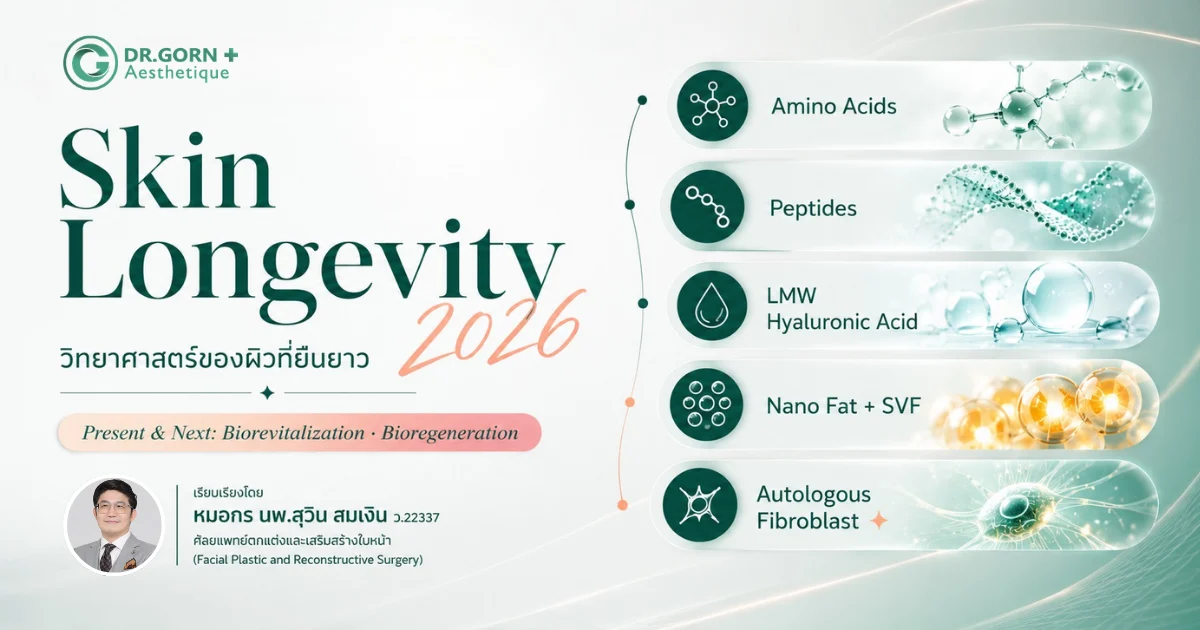
Once the Foundation Is in Place,
Skin Quality Becomes Our Next Priority
In modern aesthetic medicine, establishing a strong Facial Foundation is often the first priority. This may involve facial bone contouring, surgical enhancement for softer facial proportions, and lifting procedures using Deep Plane or SMAS techniques, with or without endoscopic assistance. For those who prefer non-surgical approaches, strategically placed dermal fillers and energy-based devices may help support facial contours and improve skin firmness.
Yet once facial proportions are balanced, another aspect is receiving increasing attention from physicians and aesthetic specialists worldwide: Skin Longevity. This concept focuses on maintaining healthy skin over the long term by supporting its natural repair processes, collagen production, and ability to retain moisture from within.
Two Approaches · Two Philosophies
Finding Your Ideal Approach:
Nature or Biomedical?
Today, Skin Longevity treatments can broadly be divided into two main approaches, reflecting different philosophies and individual preferences.
Approach 1
The Natural Approach
Harnessing Your Body's Own Resources
This approach utilizes cells and tissues derived from the individual's own body. It avoids exposure to foreign donor materials and aims to achieve natural-looking results, although treatment-related risks and complications may still occur.
Autologous Nano Fat + SVF ⬡ Autologous Fibroblasts
⬡ = Emerging · An evolving area of scientific research
Approach 2
The Biomedical Approach
Powered by Medical Science
This approach uses technologically developed or synthesized substances that are naturally present in the body. It allows for precise dosage adjustments and may offer relatively rapid improvements, with safety and effectiveness depending on the specific formulation and treatment protocol.
Amino Acids Peptides LMW-HA
Key components of Biorevitalization / Mesotherapy
Approach 1 · Autologous
Harnessing Your Own Biology:
Nano Fat + SVF and the Future of Fibroblast Therapy
Autologous Nano Fat with SVF (Stromal Vascular Fraction) involves harvesting fat from the patient's own body and mechanically processing it into Nano Fat. SVF, which contains a heterogeneous population of cells including Adipose-Derived Stem Cells (ADSCs), along with growth factors such as FGF, VEGF, and TGF, is then isolated and introduced into the skin.
77.6%
Fat graft survival rate with SVF enhancement (compared with 56.2% in the control group)
98%+
Cell viability of SVF cells when isolated using an appropriate technique
6 Months
Follow-up period during which significant improvements in wrinkles and skin texture were observed
A study published in the Journal of Plastic, Reconstructive & Aesthetic Surgery (2020), involving 50 patients, reported that SVF-assisted fat grafting produced significantly greater improvements in wrinkles and skin texture compared with conventional fat grafting (p<0.001).
Autologous Fibroblast Therapy is another emerging technique that involves collecting fibroblasts from a patient's own skin, expanding them through laboratory culture, and reintroducing them into the body. A study published in Cureus (December 2024), involving 88 patients, reported greater improvements in skin texture, firmness, and wrinkle reduction following fibroblast grafting compared with conventional hyaluronic acid injections, particularly at the three-month follow-up. This represents another promising area of investigation within regenerative medicine.
Approach 2 · Biomedical Technology
Essential Components of the Dermis:
Substances Your Body Already Recognizes
The central concept of Biorevitalization is to replenish substances naturally found within the Extracellular Matrix (ECM) of the dermis. The aim is to support fibroblasts, the cells responsible for producing collagen, and help maintain their optimal function.
1. Amino Acids — The Building Blocks of Collagen
Both polar and nonpolar amino acids serve as essential building blocks required by fibroblasts in the dermis for New Collagen Synthesis. Certain amino acids may also help protect cellular structures from degradation associated with Matrix Metalloproteinases (MMPs), enzymes involved in collagen breakdown and age-related skin changes.
A study published in Antioxidants (Basel) in 2024 found that intradermal treatment combining hyaluronic acid, amino acids, and antioxidant vitamins significantly improved cutaneous hydration and skin viscoelasticity.
Reference: Siquier-Dameto G, et al. Antioxidants (Basel). 2024;13:770
2. Peptides — Cellular Signaling Molecules
Peptides act as Cell Signaling Molecules, communicating with fibroblasts and supporting collagen production. One example is Palmitoyl Pentapeptide-4 (Matrixyl), which has been studied for its potential to promote procollagen synthesis and influence hyaluronic acid production within skin cells.
A systematic review discussed in relation to EADV Congress 2024 and IMCAS 2025 highlights peptides as active ingredients with generally favorable biocompatibility profiles and potential benefits for collagen synthesis, skin cell proliferation, and inflammation modulation.
References: Frontiers in Medicine. 2026;doi:10.3389/fmed.2026.1618306 | PMC. PMC11762834
3. LMW-HA — Low Molecular Weight Hyaluronic Acid
LMW-HA (Low Molecular Weight Hyaluronic Acid) and Non-Crosslinked HA are used in skin-quality treatments rather than primarily for volumizing, as conventional dermal fillers are. Their role includes supporting an Aquagenic Microenvironment, a moisture-rich environment within the dermis that helps maintain optimal cellular function. Research has also explored their potential effects on fibroblast activity, Type I Collagen and elastin production, and the activity of collagen-degrading enzymes such as collagenase.
A study described in Aesthetic Plastic Surgery (2023) reported that three sessions of HA Biorevitalization increased collagen density by up to 29% and reduced Transepidermal Water Loss (TEWL) by up to 18%.
References: Chahine et al. PMC12431166 | Duteil L, et al. J Clin Aesthet Dermatol. 2023;16:29–36
These three categories of ingredients may be combined in Biorevitalization / Mesotherapy, where selected substances are delivered directly into the dermis through superficial injections (Intradermal Microinjection). Potential benefits include early improvements in skin hydration and more gradual changes in skin quality associated with collagen remodeling, which may begin to develop over approximately 4–6 weeks.
What No Injection Can Replace
Biorevitalization can be a valuable component of aesthetic skin care, but achieving meaningful Skin Longevity requires attention to both external treatments and internal health. Fundamental lifestyle habits remain essential because they provide the conditions and nutrients the body needs for natural tissue repair and collagen production.
Regular Exercise
Supports the body's natural growth factor signaling
Adequate Protein Intake
Provides essential building blocks for collagen synthesis
Quality Sleep
Supports the body's natural recovery and repair processes
Skin Longevity
Beyond a Trend — A New Direction in Skin Care
In 2026 and beyond, skin care is moving beyond simply correcting visible concerns after they appear. Instead, the focus is increasingly shifting toward investing in skin quality early and maintaining it over time. Whether through nature-based approaches such as Nano Fat + SVF or biomedical technologies involving Amino Acids, Peptides, and LMW-HA, both directions are being explored through scientific research, with the shared goal of supporting fibroblast function and long-term dermal health. However, the strength of clinical evidence and regulatory status vary among treatments.
For those interested in personalized skin rejuvenation, our medical team is available to provide professional consultations and develop an individualized treatment plan based on your skin condition, lifestyle, and aesthetic goals.
Scientific References
- 1. Chahine et al. “Efficacy and Safety of Non-cross-Linked Hyaluronic Acid Injections for Facial Skin Biorevitalization.” Cureus / PMC, 2025. PMC12431166
- 2. Hirose Y, et al. “Skin Rejuvenation Using Autologous Cultured Fibroblast Grafting.” Cureus. 2024 Dec;16(12):e75405. PMC11710863
- 3. Qin J, et al. “Autologous fat graft assisted by stromal vascular fraction improves facial skin quality: A randomized controlled trial.” J Plast Reconstr Aesthet Surg. 2020. PMID 32269011
- 4. Siquier-Dameto G, Boadas-Vaello P, Verdú E. “Intradermal treatment with a hyaluronic acid complex supplemented with amino acids and antioxidant vitamins improves cutaneous hydration and viscoelasticity.” Antioxidants (Basel). 2024;13:770.
- 5. “Peptides: Emerging Candidates for the Prevention and Treatment of Skin Senescence.” PMC. Published Jan 2025. PMC11762834
- 6. “Oral and topical peptides for skin aging: systematic review and meta-analysis.” Frontiers in Medicine. 2026. Presented at EADV 2024 & IMCAS 2025. doi:10.3389/fmed.2026.1618306
- 7. Tejero García P, et al. “Facial Biorevitalization: A Regenerative Approach, with Hyaluronic Acid and Biomimetic Peptides.” Revista Ciencia y Académica. Vol.5, No.3, 2025.
- 8. Duteil L, et al. “The effects of a non-crossed-linked hyaluronic acid gel on the aging signs of the face.” J Clin Aesthet Dermatol. 2023;16:29–36. PMID 36909864


