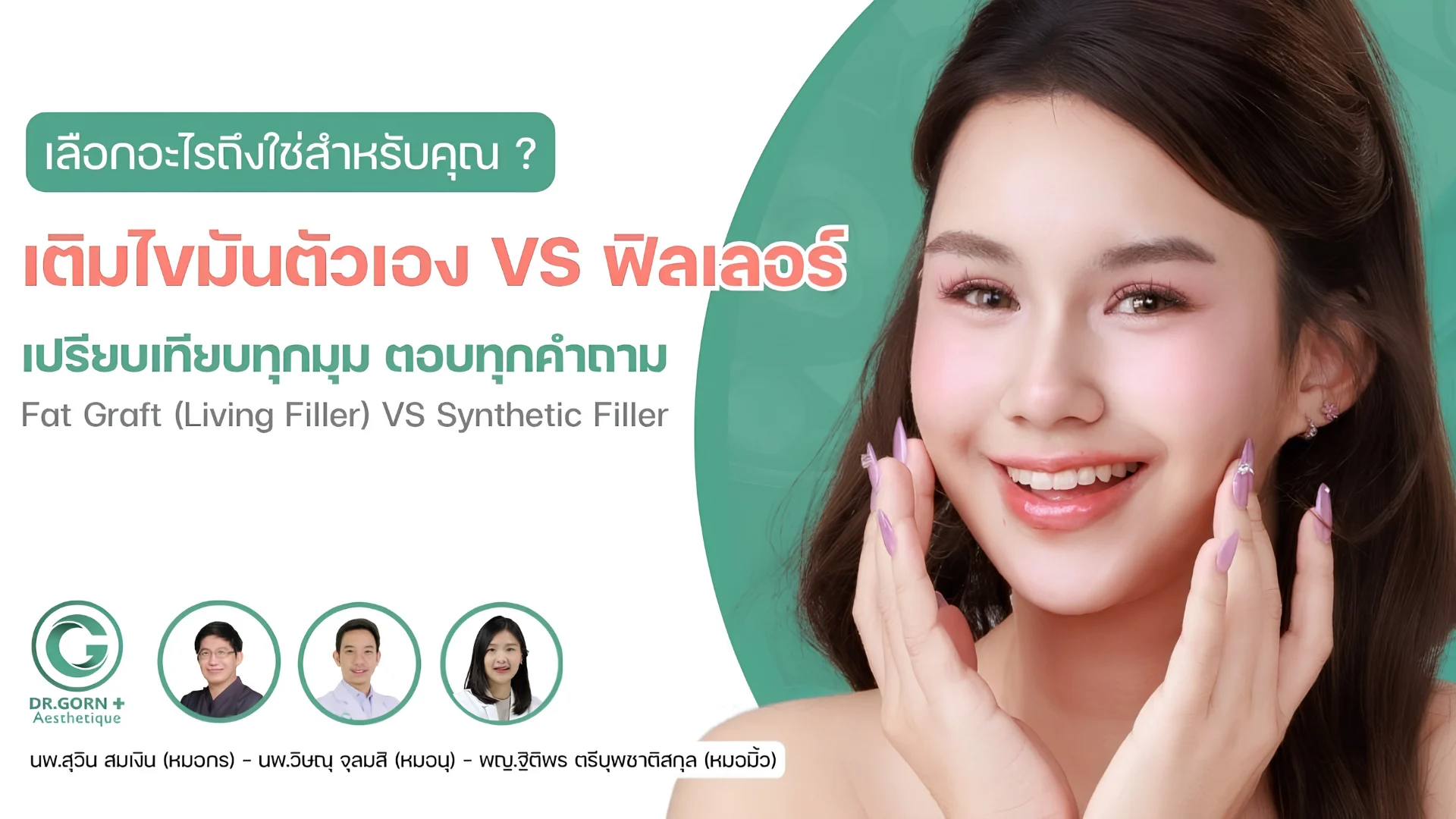
Facial Volume Restoration: What Are Your Options?
If you are looking for a way to restore facial volume, achieve a more youthful appearance, or improve deep facial folds, one of the first questions you may ask is: Which is better, autologous fat grafting or dermal filler injections? There is no single treatment that is universally better. Both have different advantages, limitations, and applications. The most suitable option depends on your facial anatomy, individual concerns, and treatment goals.
This article provides a comprehensive comparison of both methods using medical information presented by Dr.Gorn Aesthetique, a facial plastic and reconstructive surgery clinic located on Ram Inthra 109 Road in Bangkok, Thailand.
Comparison Table: Autologous Fat Grafting vs. Dermal Fillers
Here is an overview of the important differences to consider before choosing a facial volume restoration treatment.
| Comparison |  Autologous Fat Grafting (Fat Graft) Autologous Fat Grafting (Fat Graft) |
 Dermal Filler Injection Dermal Filler Injection |
|---|---|---|
| Material | Fat harvested from the patient's own body. | Manufactured injectable material, commonly hyaluronic acid (HA). |
| Allergic reactions | Allergic reactions to the patient's own fat are very uncommon, although procedural complications remain possible. | Allergic or inflammatory reactions are possible, although uncommon with approved HA fillers. |
| Volume restoration (Volumization) | Can provide soft, natural-looking volume restoration, depending on graft survival and technique. | Can provide precisely targeted, noticeable volume enhancement, depending on product characteristics and injection technique. |
| Facial contouring and structural support | Primarily restores soft-tissue volume; less suitable for providing firm structural projection. | Selected firmer HA fillers can provide greater localized projection and contour definition, but they do not replace surgical lifting. |
| Long-term skin rejuvenation | Fat-derived components are being studied for potential effects on tissue quality and skin rejuvenation; clinical results vary. | Primarily restores volume. Some HA products may also improve skin hydration, depending on formulation and use. |
| Duration of results | Successfully retained fat may provide long-lasting volume, although some grafted fat is absorbed and aging or weight changes can affect results. | Often approximately 6–18 months, depending on the HA product, treatment area, and individual factors. |
| Recovery | Commonly involves approximately 1–2 weeks of noticeable recovery, although complete healing may take longer. | Usually limited downtime, but swelling, bruising, or other reactions can occur. |
| Procedure | More complex: fat harvesting, processing, and transplantation. | Usually simpler and quicker, following medical assessment and treatment planning. |
| Suitable treatment areas | May be considered when restoring volume in several facial areas during one procedure. | Often suitable for localized correction, smaller treatment areas, or patients seeking temporary results. |
| Cost | May have a higher initial cost but can be cost-effective for extensive treatment in selected cases. | May have a lower initial cost for limited treatment, although maintenance injections can increase long-term expenses. |
Autologous Fat Grafting (Fat Graft / Living Filler)
What Is Autologous Fat Grafting?
Autologous Fat Transfer, also called Fat Grafting, is a procedure that involves harvesting fat from the patient's own body, commonly from the abdomen or thighs. The harvested fat is processed and then transferred into facial areas requiring additional volume. Because the transferred tissue comes from the patient, allergic reactions to the fat itself are very uncommon. Some successfully integrated fat cells may remain for many years, although the amount of retained fat varies and cannot be guaranteed to remain permanently unchanged.
Advantages of Autologous Fat Grafting
- Uses the patient's own tissue: The graft material is autologous, making allergic reactions to the transferred fat very uncommon. However, the procedure still carries surgical and injection-related risks.
- Natural-looking results: Fat grafting may create soft and subtle volume restoration for patients seeking an understated facial enhancement.
- Potential tissue rejuvenation benefits: Fat tissue contains stromal vascular fraction (SVF), growth factors, and cytokines that are being investigated for their potential roles in tissue repair and collagen production. However, clinical skin-rejuvenation benefits should not be considered guaranteed.
- Multiple treatment areas: Fat grafting may be used in selected areas such as the face, neck, and backs of the hands. Specialized fat-derived preparations are also being investigated for scalp and hair-related applications, where effectiveness and regulatory status should be assessed separately.
- Potentially long-lasting volume: Successfully retained fat can provide extended volume enhancement. The source article describes a broad graft survival range of 20–90%, depending on fat quality, surgical technique, and recipient tissue conditions. Actual retention varies substantially and should not be predicted using this range alone.
Disadvantages of Autologous Fat Grafting
- More complex procedure: Fat harvesting, processing, and transplantation are required.
- Variable graft retention: The source article cites a graft survival range of 20–90%. The final amount of surviving fat depends on harvesting methods, graft preparation, injection technique, recipient tissue quality, and individual healing.
- Longer recovery: Swelling and bruising may require approximately 1–2 weeks of initial recovery, with final results developing over a longer period.
- Difficult correction of excess volume: Unlike HA fillers, transplanted fat cannot be dissolved with hyaluronidase. Additional procedures, potentially including carefully planned fat removal or liposuction, may be necessary in selected cases. Fat-dissolving injections should not be assumed to be safe or suitable for every facial area.
Dermal Filler Injection Program (Synthetic Fillers)
What Are Dermal Fillers?
Dermal fillers are manufactured injectable medical materials used to restore lost volume, improve facial folds, and enhance selected facial contours. Many commonly used fillers contain hyaluronic acid (HA), which gradually breaks down over time. HA fillers may also be dissolved using hyaluronidase when clinically indicated, although the effectiveness of reversal depends on the specific product and situation.
Advantages of Dermal Fillers
- Quick and convenient: Treatment can often be performed during an outpatient appointment after appropriate consultation and assessment.
- Minimal downtime: Many patients can return to everyday activities relatively quickly, although temporary swelling or bruising may occur.
- Visible volume enhancement: Fillers can create an immediate change in facial contour, with the final appearance becoming clearer after initial swelling subsides.
- Potential reversibility: HA fillers can be treated with hyaluronidase in selected circumstances, including some cases of overfilling or complications. However, dissolving the filler does not guarantee reversal of every complication, especially severe vascular injury.
Disadvantages of Dermal Fillers
- Temporary results: Many HA fillers provide results for approximately 6–18 months, although actual longevity varies, and maintenance treatment may be desired.
- Potential reactions and complications: Allergic or inflammatory reactions may occur. Other risks include lumps, infection, asymmetry, vascular occlusion, tissue necrosis, and rare but serious vision complications.
- Not all fillers are dissolvable with hyaluronidase: Hyaluronidase is used for HA-based products, not non-HA fillers. Correction of other materials may be more complicated and sometimes require specialist procedures.
- Long-term maintenance costs: Repeated treatments across multiple facial areas can increase cumulative expenses.
Which Treatment Is Right for You? A Personal Checklist
Consider Autologous Fat Grafting If You:
- Prefer subtle, natural-looking volume restoration.
- Wish to address several treatment areas during the same procedure, such as the face, neck, or backs of the hands. Scalp or hair-related applications should be evaluated separately.
- Prefer the possibility of longer-lasting volume restoration without frequent maintenance injections.
- Are interested in potential tissue-quality benefits and understand that evidence for additional rejuvenation effects is still developing.
- Prefer using tissue harvested from your own body rather than manufactured dermal filler materials.
Consider Dermal Fillers If You:
- Want a visible change relatively quickly with limited initial downtime.
- Need correction in one or two small areas or prefer a temporary treatment.
- Are not ready for surgical fat harvesting and wish to explore a less invasive approach first.
- Want more localized contour definition using an appropriately selected filler formulation.
Frequently Asked Questions (FAQ): Fat Grafting vs. Dermal Fillers
Q1: Which lasts longer, autologous fat grafting or dermal fillers?
A: Some successfully integrated fat cells may remain for many years, particularly when body weight is relatively stable. The source article describes fat graft survival rates ranging from 20–90%, but individual results vary substantially. HA fillers are commonly described as lasting approximately 6–18 months, depending on the product and injection area. Fat grafting may offer better long-term value in selected cases, particularly when treating multiple areas, although neither treatment guarantees a permanent result.
Q2: What is the fat graft survival rate at Dr.Gorn?
A: The clinic's original article refers to a broad fat retention range of approximately 20–90%, influenced by the quality of the harvested fat, the physician's technique, and the condition of the recipient tissue. Dr.Gorn also describes using SVF and a Bio Booster following fat grafting with the aim of improving graft survival. However, this range should not be interpreted as a measured clinic-specific success rate, and the additional benefit of SVF or Bio Booster protocols requires supporting clinical evidence.
Q3: What is SVF, and how is it different from PRP?
A: Stromal Vascular Fraction (SVF) is a heterogeneous population of cells obtained from adipose tissue. Depending on processing methods, it may contain stromal cells, vascular-associated cells, immune cells, and other cellular components involved in tissue signaling. Platelet-Rich Plasma (PRP), by contrast, is prepared from blood and contains a concentrated platelet fraction. Both are being investigated for tissue repair and aesthetic applications. The source article claims that SVF offers greater concentration and effectiveness than conventional PRP, but their biological composition and clinical applications differ, and superiority has not been established across all indications.
Q4: How long is the recovery period after facial fat grafting?
A: Initial recovery generally takes approximately 1–2 weeks. Much of the early swelling may improve within 5–7 days, although bruising and swelling can persist longer. The results typically become clearer over the following 1–3 months as swelling resolves and the retained fat stabilizes. Recovery varies according to the treatment areas and individual healing.
Q5: What factors can cause transferred fat to lose volume?
A: Fat retention may be influenced by substantial weight loss, poor blood supply, smoking, individual healing, and certain uncontrolled medical conditions. The original article also mentions diabetes, liver cirrhosis, hyperthyroidism, and excessively strenuous exercise during early recovery as potential concerns. Patients should discuss their medical history and postoperative activity restrictions with their treating physician.
Q6: How is facial fat grafting at Dr.Gorn different from other clinics?
A: According to the clinic's original description, Dr.Gorn has worked on nanofat grafting techniques for more than 10 years and offers three SVF-related service levels: SVF, SVF Extra, and SVF Prime. The clinic also describes including one Bio Booster session with each case. Treatment areas discussed include the face, neck, backs of the hands, and selected scalp applications. The clinic should provide details about the preparation methods, regulatory status, supporting evidence, costs, and current availability of these services. Nanofat and SVF preparations should not be assumed to provide the same structural volume enhancement as conventional fat grafting.
Q7: Why may fat grafting to the forehead and backs of the hands cost more than treatment in other areas?
A: The forehead and backs of the hands have specific anatomical considerations, including superficial blood vessels and delicate tissue layers. Treatment in these areas requires careful planning and appropriate technical expertise. Greater procedural complexity and physician experience may contribute to higher fees, although actual prices vary by clinic and treatment plan.
Q8: Who may be better suited to dermal fillers than autologous fat grafting?
A: Dermal fillers may be preferable for patients who want relatively quick results, limited downtime, correction of one or two small areas, or a temporary alternative to surgery. They may also be useful in certain areas where predictable fat graft retention can be challenging, such as the lips. However, treatment selection should always follow an individualized assessment of anatomy, product suitability, and procedural risks.