
Semi-Open Rhinoplasty with Cartilage Tip Reshaping at Dr. Gorn Aesthetique
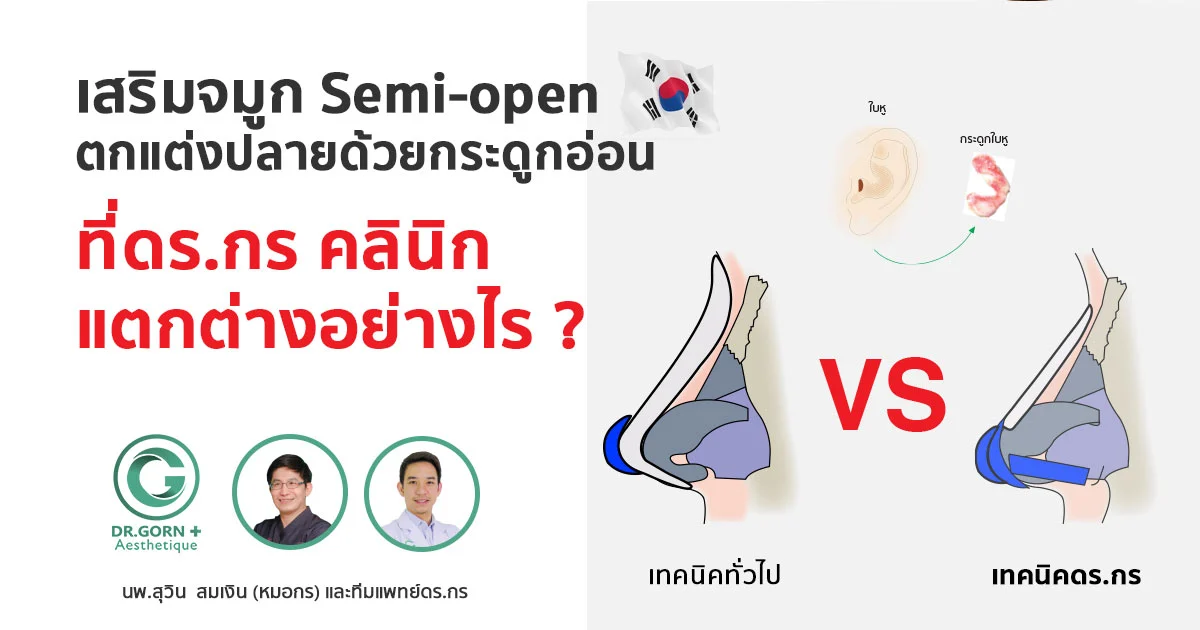
This technique uses a silicone implant only along the nasal bridge. The nasal tip is reshaped entirely with ear cartilage. The cartilage is sculpted to replace the tip and columellar portions of the silicone implant, helping lift the nasal tip and increase its length.
Semi-open rhinoplasty also focuses on creating a symmetrical pocket inside the nose. During dissection, the surgeon keeps as much of the surgical area as possible under direct visualization to reduce injury to the nasal muscles and blood vessels. This helps minimize bleeding, create a symmetrical pocket, and reduce the likelihood of deviation or tilting.
Conventional Silicone Rhinoplasty with an Ear Cartilage Tip Graft
This approach relies primarily on a silicone implant that extends to the nasal tip. A small piece of ear cartilage, approximately 0.5 square centimeters in area, is placed over the implant tip as a protective cushion. Alternatively, a dermal graft, tissue from behind the ear, or fat harvested from the buttocks may be used instead of ear cartilage. The implant pocket is created using a blind technique, in which the surgeon determines the dissection plane without direct visualization.
With this technique, excessive tension and thinning of the nasal tip may still occur if a thick, long silicone implant is used, because the implant extends all the way to the tip. This differs from the semi-open technique, which reshapes the nasal tip entirely with cartilage.
Bruising, swelling, and deviation are also described as more likely with this approach, as there is a greater possibility of injury to the nasal muscles and blood vessels. The pocket may also be more likely to lie in an uneven plane or be asymmetrical between the left and right sides.

Benefits of Semi-Open Rhinoplasty with a Tip Reshaped Entirely Using Cartilage
This technique can increase nasal tip projection and length while aiming for a natural appearance and a safe outcome. The clinic describes the likelihood of future nasal tip thinning or implant exposure as very low compared with rhinoplasty using silicone alone.
The technique is also described as producing less swelling and bruising and a lower likelihood of deviation, because the implant pocket is created in an appropriate plane with symmetry between both sides.
Who May Be Suitable for This Technique?
This technique is suitable for patients with thin nasal tip tissue and weak tip support, provided the nose is not excessively short. For patients with a large, thick nasal tip, a doctor should assess which approach is appropriate for reducing its size. Patients with a short nasal tip may require structural nasal reconstruction to increase nasal length.
Will Harvesting Ear Cartilage Affect the Ear?
Only part of the ear cartilage is harvested, while the main supporting cartilage framework is preserved. This allows the ear to retain its original shape without deformity, and hearing remains unchanged.
Semi-Open Rhinoplasty with Ear Cartilage Tip Reshaping vs. Conventional Cartilage Tip Cushioning
| Comparison | Conventional Cartilage Tip Cushioning | Dr. Gorn's Cartilage Tip Reshaping Technique |
|---|---|---|
| Silicone Implant Length | Extends to the nasal tip | Limited to the nasal bridge |
| Use of Cartilage | A cartilage sheet cushions the silicone implant tip | Cartilage is specially sculpted to lift and shape the nasal tip, replacing the tip and columellar portions of the implant |
| Likelihood of Nasal Tip Thinning | Possible | Very low under normal conditions |
| Nasal Tip Movement After Surgery | The tip can move | The tip can move more freely |
| Natural Appearance | Less natural | More natural |
| Revision Cases with Silicone-Related Tip Thinning | Not recommended due to a high likelihood of recurrence | Can be used for correction |
| Surgical Difficulty | Easier | More difficult |
| Creation of the Implant Pocket | A blind technique, with a greater likelihood of uneven dissection planes or asymmetry | Performed under direct visualization as much as possible, especially from the middle of the nose to the tip, allowing a more appropriate and symmetrical dissection plane |



