
Why Do We Prefer the High SMAS and Modified Deep Plane Facelift?
Facelift surgery has become increasingly popular in Thailand and internationally. Over the years, facelift techniques have continued to evolve, offering surgeons more options for addressing facial aging and overcoming some of the limitations associated with traditional facelift procedures developed over the past century.
However, there is still a common misconception that all facelift techniques involve the same surgical approach and produce similar results. In reality, facelift methods differ in several important aspects, including surgical complexity, operating time, the anatomical layers treated, the degree of tissue repositioning, recovery, and the longevity of the results. Some patients may experience only modest improvement, while others may develop an unnatural appearance, noticeable incision scars, or results that do not last as long as expected. These concerns can make patients hesitant about undergoing facelift surgery.
Based on nearly 20 years of experience performing deep-layer facelift procedures, Dr. Gorn believes that carefully selected surgical techniques can help achieve natural-looking and potentially long-lasting facial rejuvenation. The direction of tissue repositioning should respect the patient's original facial anatomy and natural contours. In revision cases, dissatisfaction with a previous facelift may be associated with a variety of factors, including the surgical approach, tissue characteristics, healing, or changes that occur with aging.
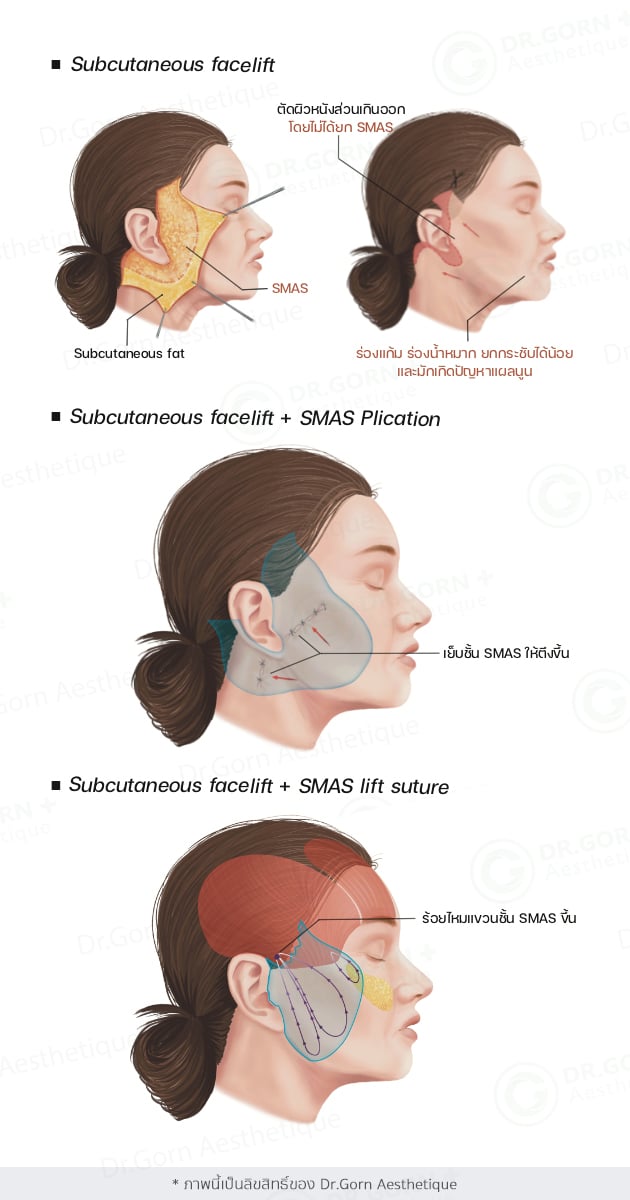
Some patients undergoing revision facelift surgery previously received a subcutaneous facelift, which primarily involves lifting the skin and superficial tissues. Others may have undergone additional procedures using suspension materials or manipulation of the Superficial Musculoaponeurotic System (SMAS), such as SMAS plication. These approaches may be appropriate for selected patients, but the original article highlights several factors that can limit the results in certain cases:
- Superficial facial fat: Changes in the superficial fat compartments can influence facial contours and the visible effects of lifting.
- Excessive skin removal and wound tension: Removing too much skin or placing excessive tension on the incision can contribute to wider or more noticeable scars, including hypertrophic scarring in susceptible patients.
- Insufficient repositioning of the SMAS: When deeper supporting structures are not adequately addressed, improvement in the nasolabial folds, marionette lines, and midface may be limited.
- SMAS plication: This technique involves folding and suturing the SMAS to create additional support and tightening. Its effectiveness depends on the patient's anatomy and the surgical design.
- SMAS suspension with sutures or threads: Suspension methods may provide support in selected situations, but they differ from extensive surgical release and repositioning of deeper facial tissues.
High SMAS and Modified Deep Plane Facelift: Surgery Beneath the SMAS Layer
According to Dr. Gorn, more than 90% of the face and neck lift cases in his current practice are performed using deep-layer surgical techniques, including approaches involving dissection beneath the SMAS layer. These procedures allow the surgeon to address deeper facial supporting tissues and retaining ligaments, with the aim of improving the midface, nasolabial folds, marionette lines, jawline, and neck contours while maintaining a natural-looking facial appearance.
The High SMAS and Modified Deep Plane Facelift involves surgical dissection and repositioning of facial tissues at a deeper level, beneath the Superficial Musculoaponeurotic System (SMAS). The technique may include the controlled release of selected facial retaining ligaments to allow the SMAS and associated soft tissues to move into a more elevated position. By addressing deeper support structures rather than relying primarily on skin tension, this approach aims to provide effective facial lifting while reducing excessive pulling on the skin incision.
Dr. Gorn's preferred technique emphasizes individualized control of the lifting direction for different areas of the face. The deeper tissue layers are repositioned first, followed by redraping the overlying skin. This can help distribute tension through deeper supporting structures and may reduce excessive tension along the skin closure. However, the degree of improvement, scar appearance, and duration of results vary between patients. No technique can guarantee scar-free healing or universally superior long-term outcomes.
High SMAS and modified deep plane techniques may be considered for patients with more pronounced facial laxity, deep nasolabial folds, descending mouth corners, visible jowls, submental fullness, and neck skin laxity. They may also be considered for selected patients seeking revision facelift surgery after previous procedures. The suitability of this approach should be determined through a detailed examination of facial anatomy and the patient's treatment goals.

Comparing High SMAS, SMAS Lifting, and Subcutaneous Facelift Techniques
Deep plane facelift procedures involve operating close to important anatomical structures, including branches of the facial nerve and facial blood vessels. Therefore, they require careful knowledge of facial anatomy, precise surgical dissection, and appropriate experience. Depending on the extent of correction, these operations may also take longer than more limited facelift procedures. The original article presents the following comparison of surgical approaches.
| Comparison | High SMAS and Modified Deep Plane Facelift | SMAS Lift Surgery | Subcutaneous Facelift Surgery |
| Surgical Dissection Level | Deep dissection beneath the SMAS layer | SMAS manipulation, plication, or lifting; the exact dissection plane varies by technique | Primarily beneath the skin, within the superficial tissue plane |
| Surgical Complexity | Highly complex, requiring detailed anatomical knowledge | Varies from moderate to complex depending on the specific SMAS technique | Generally less extensive deep-tissue dissection, although careful surgical technique remains essential |
| Approximate Operating Time | More than 6 hours in the original clinic comparison | Approximately 2–4 hours in the original comparison | Approximately 2–3 hours in the original comparison |
| Facial Lifting Effect | Designed to reposition deeper supporting tissues, potentially improving the midface, nasolabial folds, jawline, and neck | Can improve facial laxity through SMAS tightening or repositioning | Primarily addresses skin laxity; deeper structural correction may be more limited |
| Natural-Looking Results | Aims to restore facial contours through deeper tissue repositioning | Can produce natural-looking results when appropriately performed | May produce natural-looking results in suitable patients, although excessive skin tension can affect appearance |
| Longevity of Results | Potentially long-lasting; depends on anatomy, aging, and technique | Varies according to the technique and patient characteristics | Varies by patient and procedure; a fixed duration of one year cannot be assumed |
| Risk of Hypertrophic Scarring | Reducing skin-closure tension may be beneficial, but abnormal scarring remains possible | Depends on incision tension, healing, and individual susceptibility | Excessive skin tension may increase scar-related concerns |
| Surgeon Expertise | Requires advanced training and experience with deep facial anatomy | Requires experience with the selected SMAS technique | Requires appropriate facelift training, judgment, and surgical experience |
Before undergoing facelift surgery, patients should consult the surgeon who will perform the procedure. A detailed consultation should cover the selected surgical technique, the areas of the face and neck that can realistically be improved, the expected recovery process, the potential longevity of results, and possible complications. Choosing a surgical approach should be based on individual anatomy and treatment objectives rather than the technique's name alone.



