
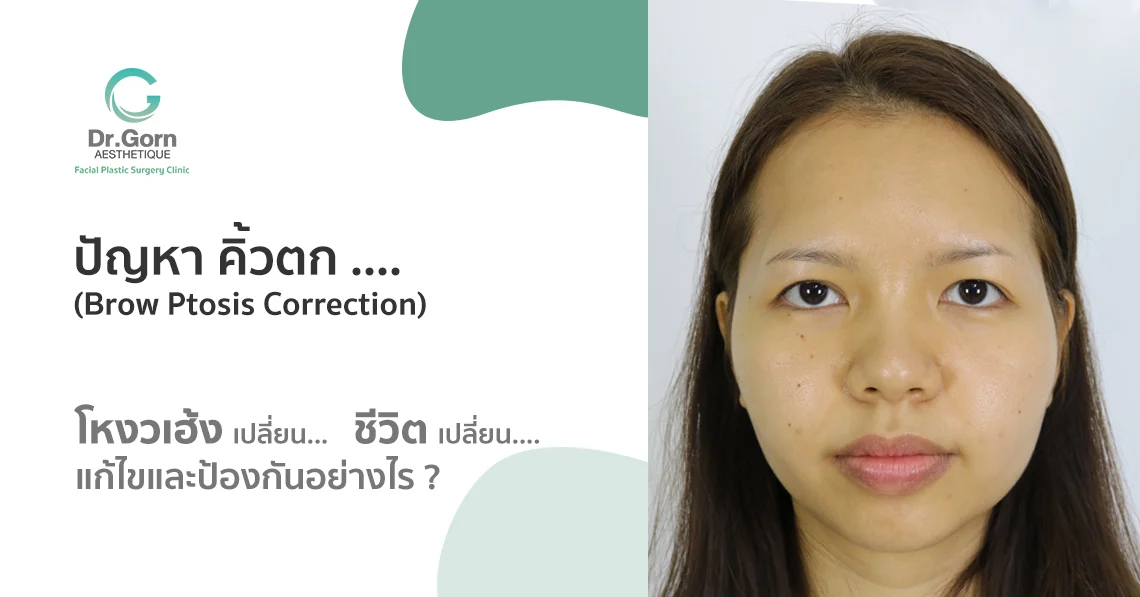
Forehead wrinkles, drooping eyebrows, a receding hairline, and drooping outer eye corners often occur together as part of age-related changes in the upper face. Brow lift surgery can help create a more youthful appearance and lift the excess skin that hangs over the outer upper eyelids, known as lateral hooding, allowing the natural eyelid crease to become more visible.
Drooping Inner Eyebrows (Medial Brow Ptosis)
When the inner eyebrows droop, the face may appear angry, displeased, or stern, even when these expressions do not reflect the person’s actual mood or personality.
Drooping Outer Eyebrows (Lateral Brow Ptosis) and Lateral Hooding
The outer eyebrows often descend earlier than the inner eyebrows. This can affect the appearance and function of the eyes in several ways:
- The face may appear sad, tired, or lacking in energy.
- The upper eyelid skin may descend with the eyebrows and obscure the original eyelid crease. Uneven eyebrow descent can also make the eyelid creases appear asymmetric.
- In more severe cases, the overhanging tissue may obstruct part of the visual field and interfere with vision.
Brow drooping may also contribute to frequent headaches in some people because the forehead muscles repeatedly contract to hold the eyebrows up. Over time, this compensatory effort can contribute to deep horizontal forehead lines that remain visible even at rest.
The importance of addressing brow drooping varies from person to person. Relevant factors include the severity of the drooping, its effect on everyday life, personal aesthetic preferences, and cultural beliefs about facial appearance. In women, pronounced brow descent or a naturally low brow position may create a stronger or more traditionally masculine appearance and reduce the softer look they prefer.
Eyebrow Anatomy
Understanding eyebrow anatomy helps guide an appropriate approach to assessment and treatment. Key considerations include:
- Which eyebrow positions and shapes are commonly associated with a youthful appearance.
- How typical eyebrow characteristics differ between men and women.
- Which factors influence eyebrow position.
How Do Typical Male and Female Eyebrows Differ?
Men
Male eyebrows typically have a relatively horizontal shape with little arch and sit approximately at the level of the superior orbital rim, the upper bony edge of the eye socket. Eyebrow thickness and density are often relatively consistent along their length.
Women
Female eyebrows commonly have an arched shape and sit above the superior orbital rim. Their shape also varies with personal preferences and beauty trends. The inner eyebrow is usually fuller and gradually tapers toward the outer tail. The highest point of the arch is often near the junction between the inner two-thirds and outer one-third of the eyebrow.

Female Eyebrow Proportions in Relation to the Eyes, Eye Sockets, and Eyelid Creases
- The inner eyebrow is typically positioned slightly lower than the outer tail.
- The inner eyebrow generally aligns with the inner corner of the eye, known as the medial canthus.
- The outer eyebrow gradually tapers and ends near the lateral orbital rim, the outer bony edge of the eye socket.
One commonly described aesthetic proportion divides the distance from the lower eyebrow border to the upper eyelid margin into three parts. The distance from the eyebrow to the eyelid crease accounts for approximately two-thirds, while the visible eyelid between the crease and the eyelid margin accounts for approximately one-third. These proportions are a reference rather than a fixed standard for every face.
Factors That Influence Eyebrow Position
Forehead Muscle (Frontalis Muscle)
The frontalis muscle has a portion on each side of the forehead. It raises the eyebrows and contributes to movement of the forehead and hairline. It becomes more active when we raise our eyebrows, express surprise, or compensate for difficulty lifting the upper eyelids, as may occur with upper eyelid ptosis.
If this compensatory activity continues or eyebrow raising becomes a repeated habit, horizontal forehead lines may become more pronounced.
Muscles Around the Eyes (Periocular Muscles)
At the inner eyebrow, four muscles contribute to eyebrow movement:
- Corrugator supercilii.
- Depressor supercilii.
- The medial portion of the orbicularis oculi.
- Procerus.
These muscles are collectively referred to as the glabellar complex because they are located around the area between the eyebrows. When they contract during frowning, concentrating, staring, or squinting, they can pull the inner eyebrows downward and create a tense, stern, or worried appearance.
At the outer eyebrow, contraction of the lateral portion of the orbicularis oculi can pull the eyebrow tail downward. This muscle is active during expressions and movements such as squinting, smiling, and laughing.
The Bony Contour of the Superior Orbital Rim
The superior orbital rim provides underlying support for the eyebrow region. The outer portion generally offers less prominent bony support than the inner portion, which may contribute to earlier descent of the eyebrow tail. Age-related changes in the underlying bone can also alter this support and contribute to changes in eyebrow position.
Facial Supporting Ligaments
Facial supporting ligaments help anchor the eyebrow, forehead, and temple tissues to deeper structures, including the periosteum that covers the bone. As these supporting structures become more lax with age, the eyebrows may gradually descend under the influence of gravity.
Can Brow Drooping Be Prevented or Delayed?
Brow drooping cannot be completely prevented because the supporting ligaments, underlying bone, and other facial tissues change with age. However, caring for overall health and managing repeated muscle tension may help support the appearance of the upper face.
- Manage stress and make time to relax. Frequent or prolonged frowning and squinting can increase tension around the eyes and make forehead lines, crow’s feet, and frown lines more noticeable.
- Maintain a balanced, nutritious diet. Eating well supports overall health.
- Get sufficient rest. Adequate sleep supports the body’s normal repair and recovery processes.
- Discuss muscle-relaxing injections with a qualified doctor. In selected patients, injections may reduce the activity of muscles that pull the eyebrows downward. Treatment intervals should be tailored to the individual rather than follow a fixed schedule. Particular care is needed when treating forehead wrinkles in people who already have low eyebrows, brow drooping, or upper eyelid ptosis. Relaxing the forehead muscles may reduce their compensatory lifting effect and worsen eyebrow or eyelid drooping.
How Can Drooping Eyebrows Be Treated?
A consultation with a specialist is recommended before choosing treatment. The suitability of each brow lift technique depends on the degree of drooping, facial anatomy, eyebrow shape, and upper eyelid condition. Each option has different benefits and limitations, which should be discussed alongside the patient’s expectations.
Younger Patients or Mild Brow Drooping
Less invasive options may be considered for mild brow drooping, although the degree of lifting may be modest and the effects may be temporary.
- Muscle-relaxing injections: In suitable cases, these may produce a small lift, sometimes around 2 mm. The degree and duration of improvement depend on factors such as anatomy, injection technique, and dosage.
- Thread lifting: The original article describes the author’s clinical experience as showing limited improvement and short-lasting effects. Suitability and expected results should be discussed individually.
- Energy-based treatments: Treatments such as HIFU, laser, or radiofrequency may be used to promote tissue tightening. Improvement may be limited, and repeat treatments may be needed. Careful treatment planning is important around the temples and forehead, particularly where the frontal branch of the facial nerve passes and in patients with very thin tissues.
Older Patients or More Pronounced Brow Drooping
Forehead and brow lift surgery offers several techniques. The choice of approach depends on factors such as:
- The amount of excess forehead skin and the extent of forehead wrinkling.
- The shape of the forehead and underlying frontal bone.
- The height and position of the hairline.
- Differences in eyebrow height between the two sides.
- The patient’s expectations regarding how long the results may last.
- Any previous double eyelid surgery or upper or lower eyelid surgery, including the techniques used.
- Previous eyebrow tattooing or permanent makeup, including whether its position was planned with a future brow lift in mind.



